The coffee tree has been cultivated for centuries.
Its beans have shaped cultures, economies, and daily rituals around the world.
But one question kept returning:
What about the leaf?
While coffee farmers dedicate their lives to growing exceptional coffee, the leaves have largely remained overlooked. Yet they grow on the same tree, under the same sun, nourished by the same soil.
We wondered what might happen if we gave the leaf the same attention that coffee has received for generations.
That question became Teebica.
Most coffee production focuses on a single part of the plant: the bean.
Teebica takes a different approach.
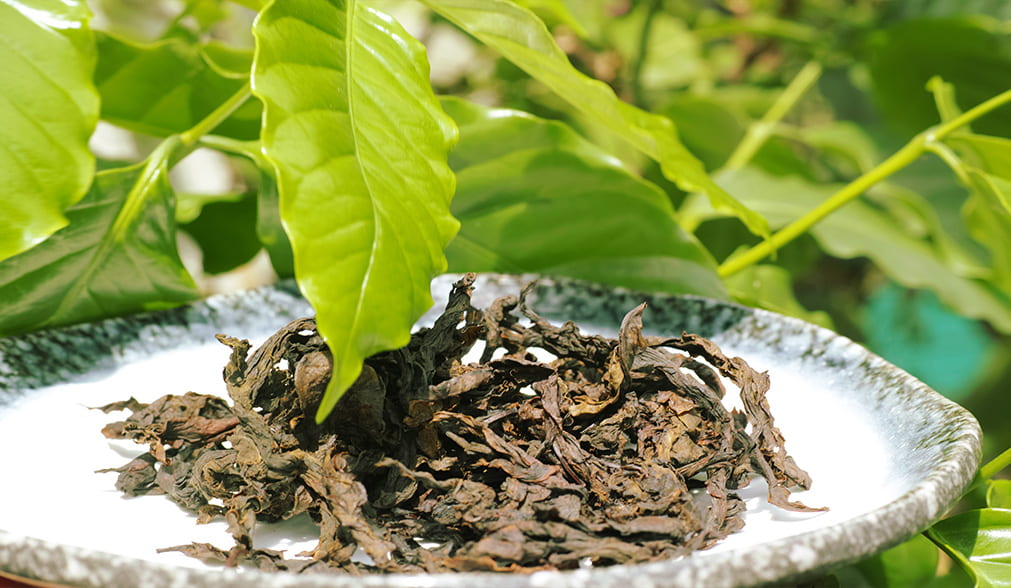
By carefully selecting semi-mature Arabica leaves and applying our proprietary processing method, we reveal a completely different expression of the coffee tree.
The result is a smooth, refreshing infusion with a character unlike traditional coffee or tea.
A familiar plant.
A completely different experience.
Our leaves are sourced from Arabica coffee trees grown in the highlands of Northern Thailand.
The region's elevation, climate, and growing conditions help create leaves with exceptional character and quality.
Every batch is carefully harvested and processed with the same attention to detail that great coffee deserves.
Because we believe the leaf should never be an afterthought.
For most of my life, I looked at coffee trees the same way everyone else did.
The bean was everything.
The leaves were simply part of the plant.
We harvested cherries. We processed coffee. We roasted coffee. We sold coffee. Like generations of coffee farmers before us, our attention was always focused on what happened inside the fruit.
Yet every year, millions upon millions of leaves grew on the very same trees.
Nobody talked about them.
Nobody harvested them.
Nobody seemed interested in them.
The more I thought about it, the stranger it became.
How could one of the world's most studied and traded plants have a part that was almost completely ignored?
One day, standing among our Arabica trees in the mountains of Northern Thailand, I began looking at the coffee plant differently.
Not as a coffee producer.
Not as a coffee roaster.
But simply as a curious observer.
The leaves were healthy, vibrant, and abundant. They shared the same soil, the same climate, and the same genetics as the cherries we valued so highly.
What if we had been overlooking something important?
That simple question started a journey.
At first, the results were disappointing.
Some leaves produced harsh infusions. Others were bitter. Many processing methods simply didn't work.
Most attempts ended in failure.
But occasionally there were glimpses of something unexpected.
A cup that was smoother.
A cup that was sweeter.
A cup that made us stop and look at one another.
Those moments kept us going.
What began as curiosity slowly turned into obsession.
The deeper we explored, the more we discovered. Scientific literature revealed that coffee leaves contained a fascinating spectrum of naturally occurring compounds. Historical records showed that people in some coffee-growing regions had consumed coffee leaf beverages for generations.
The leaf had never truly been forgotten.
It had simply never received the attention given to the bean.
Years of experimentation eventually led us to a process that revealed what we believed the coffee leaf could become.
Not coffee.
Not tea.
Something entirely its own.
Smooth.
Refreshing.
Distinctive.
Teebica was born from that discovery.
Today, when we walk through our coffee farms, we still see the same trees.
But we no longer see only beans.
We see possibility.
Because sometimes innovation is not about inventing something new.
Sometimes it is about finally noticing what was there all along.
Respect the tree.
Respect the farmer.
Respect the process.
Remain curious.
Because after centuries of celebrating the bean, we believe the leaf deserves its moment too.